Starting a business is exciting. Every entrepreneur begins with a dream—whether it’s building the next unicorn or creating a profitable business that supports their family for generations. However, before thinking about funding, scaling, or marketing, there is one question every founder should answer honestly:
“Am I building a startup or a small business?”
Many people use these terms interchangeably, but they are not the same. The difference goes far beyond terminology. It influences how you raise capital, define success, hire people, grow your business, and even the amount of risk you’re willing to take.
Over the years, I’ve noticed that many founders don’t fail because their idea is weak or because they lack the ability to execute. They struggle because they misunderstand the type of business they are actually building. When your strategy doesn’t match your business model, even a good idea can lose direction.
A Conversation That Inspired This Blog
A few days ago, someone approached me for help in raising investment. Since I regularly work with founders and entrepreneurs, my first question was simple:
“What is your business model?”
He explained that he planned to procure makhana from farmers across India and export it to international markets. It sounded like a promising business opportunity. India’s makhana exports have been growing steadily, and there is increasing demand for healthy food products in global markets.
As our conversation continued, he confidently referred to his venture as a startup.
That immediately caught my attention.
I explained that while his idea certainly had business potential, not every new business is a startup. Based on what he described, his venture was essentially an export trading business built around an existing business model. Unless he was introducing something fundamentally different—such as proprietary technology, an AI-powered procurement system, a disruptive supply chain, or a scalable digital platform—it would be more accurately classified as a small business rather than a startup.
He was surprised.
Like many first-time entrepreneurs, he believed that launching a new business automatically made him a startup founder.
In reality, the distinction is much deeper than that.
And this is not an isolated example.
Almost every week, I meet entrepreneurs who proudly introduce themselves as startup founders. But when I ask them about their growth plans, target market, funding strategy, and long-term vision, they often describe a traditional small business. I have also seen the opposite—founders building genuinely scalable businesses while operating with the mindset of a small business owner.
There is nothing wrong with either approach.
The problem begins when founders choose strategies that don’t align with the type of business they are building.
A local business owner may spend months chasing venture capital that isn’t suitable for their business, while a startup founder may avoid raising capital altogether and lose valuable time to well-funded competitors.
Both mistakes are expensive.
That is why understanding the difference between a startup and a small business is one of the first lessons every entrepreneur should learn.
What Is a Startup?
A startup is not simply a newly registered company.
Many people assume that if a business is less than two or three years old, it automatically qualifies as a startup. That is one of the biggest misconceptions in entrepreneurship.
A startup is a business built for explosive and scalable growth.
The objective isn’t just to sell a product or provide a service. The objective is to create a business model that can expand rapidly and serve a much larger market without increasing costs at the same pace.
Let’s look at a few familiar examples.
Flipkart didn’t just sell books online. Its founders built an e-commerce platform that could eventually sell almost anything to anyone across India.
Zomato didn’t simply publish restaurant menus. It created a technology platform capable of connecting restaurants and customers while expanding into food delivery, dining experiences, and multiple international markets.
Similarly, Ola didn’t build another taxi company. It built a technology-driven network capable of connecting millions of riders with drivers across different cities.
Notice the common pattern?
Each of these businesses was designed to scale.
That scalability is what separates a startup from a traditional business.
Another important characteristic of a startup is uncertainty.
A startup doesn’t begin with all the answers. Founders continuously experiment with pricing, products, customer segments, marketing strategies, and business models until they discover what investors often call product-market fit.
In simple words, a startup is constantly searching for a business model that can be repeated and scaled successfully.
This is also why startup failure rates are so high.
Industry studies often suggest that nearly 90% of startups fail.
Contrary to popular belief, most startups don’t fail because the founders aren’t intelligent or because the idea is terrible. They fail because they cannot discover a scalable business model before running out of time or capital.
Building a startup therefore requires patience, experimentation, resilience, and a willingness to embrace uncertainty.
What Is a Small Business?
A small business is built with a very different objective.
Instead of pursuing exponential growth, its primary goal is to generate stable income while serving a defined group of customers.
Success is measured through profitability, customer satisfaction, and long-term sustainability rather than rapid expansion.
Think about the businesses you interact with every day.
It could be a neighbourhood grocery store that has served the same community for decades, a family-owned restaurant with loyal customers, a Chartered Accountant helping businesses with taxation and compliance, or a plumbing service that solves local household problems.
These businesses don’t need millions of users or international investors to become successful.
They simply need satisfied customers, healthy cash flow, and sustainable operations.
Unlike startups, small businesses generally operate in proven markets where customer demand already exists. Rather than trying to disrupt an industry, they focus on providing reliable products and services while steadily growing their customer base.
Many small businesses continue operating successfully for generations.
In fact, small businesses form the backbone of every economy. They generate employment, strengthen local communities, and contribute significantly to economic growth.
Building a successful small business should never be viewed as a lesser achievement.
It is simply a different entrepreneurial journey with different goals.
Why Confusing the Two Is Dangerous
The real problem isn’t choosing a startup over a small business or vice versa.
The real problem is confusing one for the other.
When founders misunderstand what they are building, they begin making decisions that don’t support their business model.
Imagine you’re building a local accounting practice, restaurant, or export business but convince yourself that you’re running a startup. You may spend months pitching to venture capital investors, dilute your ownership unnecessarily, and face unrealistic expectations for growth.
On the other hand, imagine you’ve built an innovative technology platform capable of serving millions of customers but refuse to raise capital because you believe every business should grow only through personal savings.
By the time you’re ready to scale, well-funded competitors may already dominate the market.
I’ve seen both situations happen.
Both are painful.
Both are avoidable.
The first step towards making better business decisions is simply understanding what type of business you’re actually building.
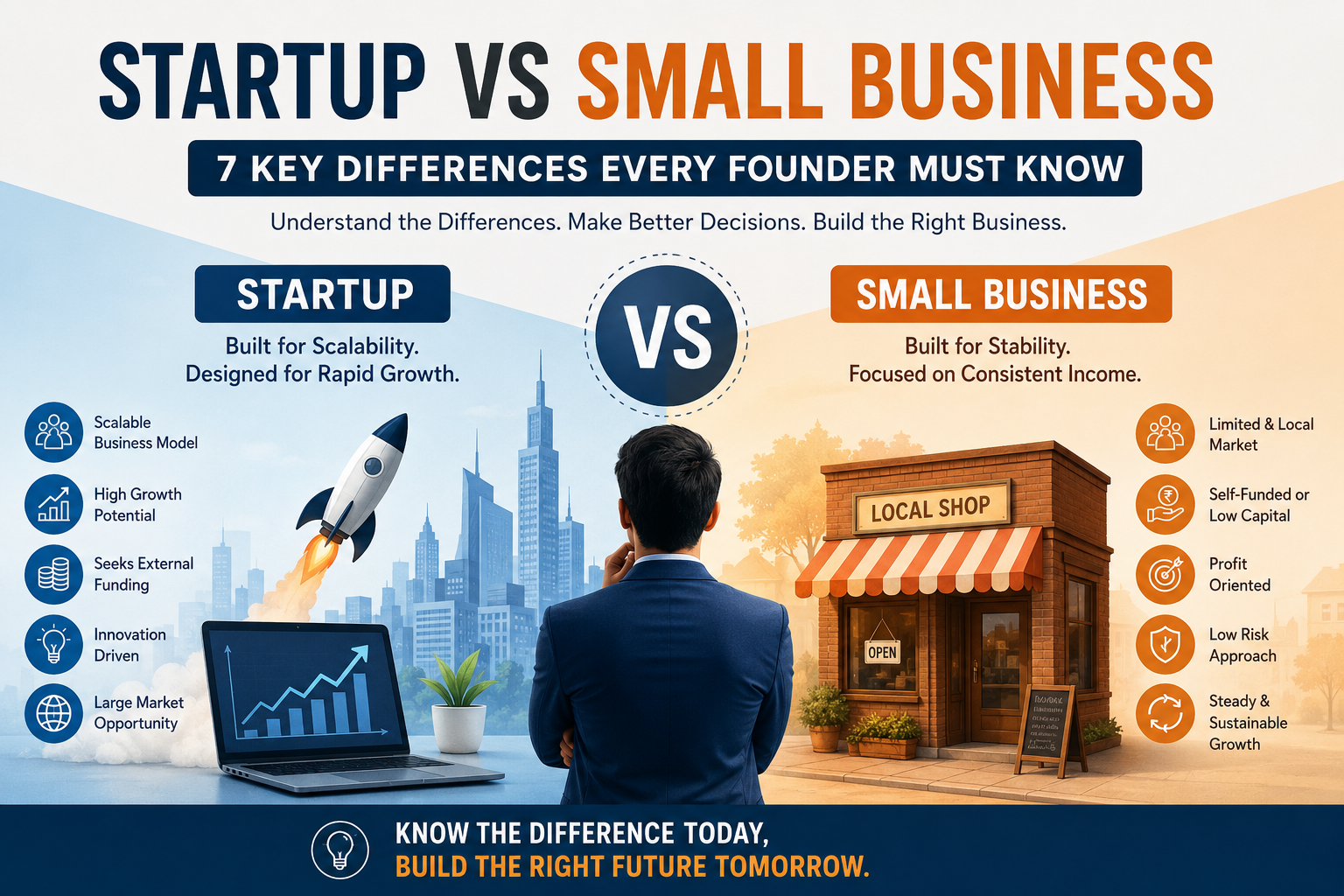
In the next section, let’s compare startups and small businesses across seven important parameters that every entrepreneur should understand before deciding their growth strategy.
Written By
CA Roshan Jha
Founder, Startup Solutions 247