Every New Business Isn’t a Startup—And That’s Perfectly Fine
Walk into any networking event or entrepreneurship seminar today, and you’ll hear people introducing themselves as startup founders. Ask a simple follow-up question—“What type of startup are you building?”—and the conversation often becomes uncertain.
Many entrepreneurs assume that launching a new business automatically makes it a startup. In reality, there is a significant difference between starting a business and building a startup. Understanding this distinction is important because it influences almost every major business decision, including fundraising, hiring, product development, customer acquisition, marketing strategy, and long-term growth.
I recently had a conversation with an entrepreneur who approached me for assistance in raising investment. Knowing that I work closely with founders, he wanted to explore funding opportunities for his business. My first question was straightforward:
“What is your business model?”
He explained that he planned to procure makhana from farmers in India and export it to international markets. It was a promising business idea with clear commercial potential. However, it also highlighted one of the most common misconceptions among first-time entrepreneurs.
While his business was new, it wasn’t necessarily a startup in the venture capital sense. Unless the company introduced a disruptive technology, a scalable digital platform, or an innovative supply chain that fundamentally changed the industry, it would be better classified as an export trading business or small business rather than a startup.
This distinction matters because different businesses require different funding strategies. A venture capitalist searching for a technology-driven company may not invest in a traditional trading business, whereas banks, angel investors, or MSME financing schemes could be a much better fit.
The lesson is simple: before seeking investment, every entrepreneur should first understand what type of business they are actually building.
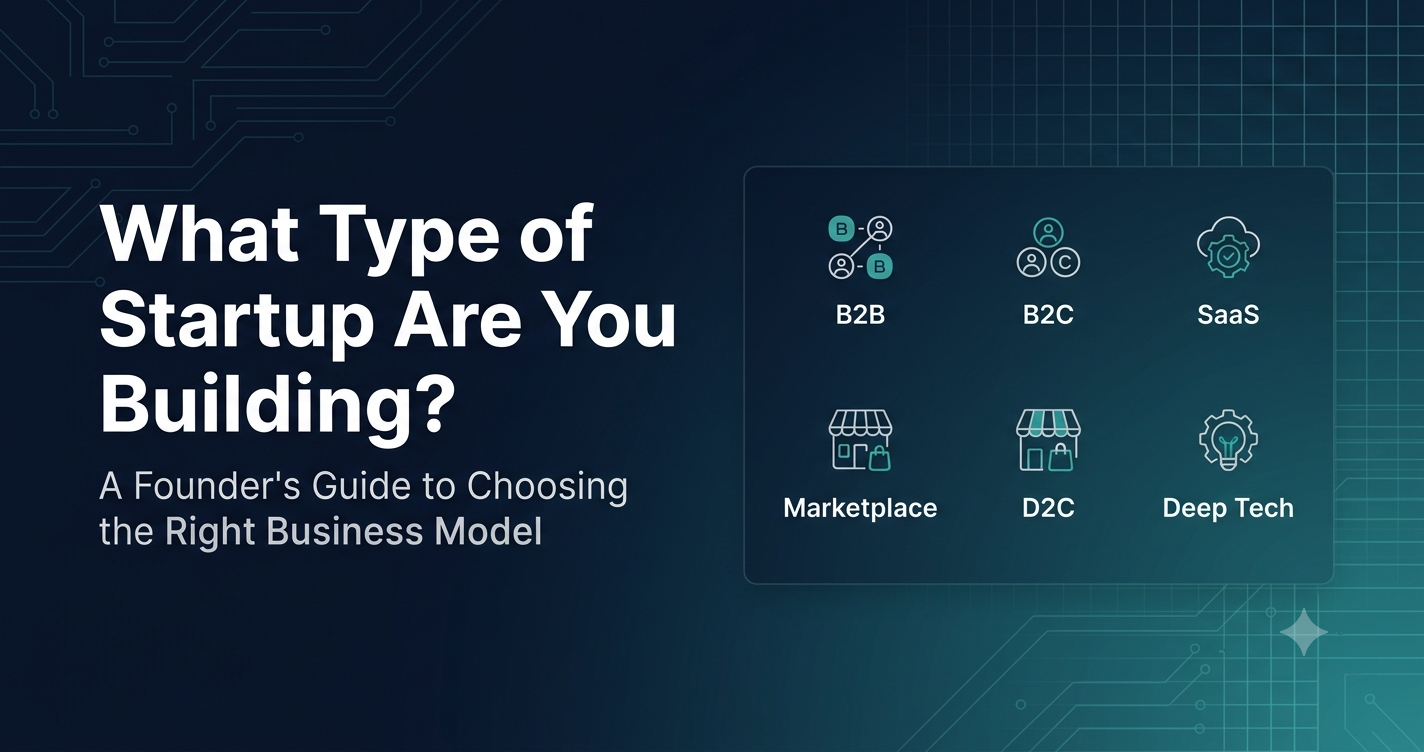
In this article, we’ll explore the seven major startup models that dominate today’s entrepreneurial ecosystem, understand how each operates, and help you identify which one aligns best with your vision.
Why Identifying Your Startup Type Matters
Your startup model is much more than a label. It shapes your entire entrepreneurial journey.
It determines:
- The customers you serve.
- The revenue model you adopt.
- The investors you approach.
- The skills your founding team should possess.
- Your marketing strategy.
- The pace at which your business can scale.
- The level of capital required.
- Your long-term exit opportunities.
Many founders spend months preparing pitch decks without first asking whether their business actually fits the expectations of startup investors. Choosing the right model early helps avoid costly mistakes and allows founders to focus their energy where it creates the greatest impact.
Let’s explore the most common startup models one by one.
1. B2B Startups (Business-to-Business)
Solving Business Problems Instead of Consumer Problems
A Business-to-Business (B2B) startup sells its products or services to other businesses rather than directly to individual consumers.
Unlike consumer businesses where purchasing decisions can happen within minutes, B2B sales usually involve multiple stakeholders, procurement teams, budget approvals, and lengthy negotiations. While the sales process may take longer, successful B2B companies often enjoy higher contract values, predictable revenue, and long-term customer relationships.
Is B2B Right for You?
You may be building a B2B startup if you enjoy solving operational challenges for businesses, understand enterprise workflows, and are comfortable managing long sales cycles.
Professionals with experience in consulting, finance, manufacturing, software development, logistics, or enterprise operations often transition successfully into B2B entrepreneurship because they already understand how businesses make purchasing decisions.
Examples
India has produced several globally successful B2B startups, including:
- Zoho
- Freshworks
- Druva
- Postman
These companies built products specifically for businesses and expanded far beyond India by solving universal business challenges.
What Does the Business Model Look Like?
Typical characteristics of B2B startups include:
- Sales cycles ranging from one month to twelve months.
- Higher deal values compared to consumer businesses.
- Multiple decision-makers involved before a purchase.
- Long-term contracts and recurring business relationships.
- Greater emphasis on customer support and account management.
Although acquiring enterprise customers requires patience, retention rates are generally stronger because businesses are less likely to switch vendors once systems become integrated into their operations.
Founder Insight
One mistake many first-time founders make is assuming that an excellent product will automatically generate enterprise customers. In reality, successful B2B companies invest heavily in relationship building, trust, customer success, and after-sales support.
Building credibility is often just as important as building technology.
2. B2C Startups (Business-to-Consumer)
Selling Directly to Individual Customers
Business-to-Consumer (B2C) startups focus on individual buyers rather than businesses.
Whether someone orders food through an app, purchases clothing online, or books travel from their smartphone, they are interacting with a B2C business.
Consumer purchasing decisions are usually emotional, convenience-driven, and much faster than enterprise buying decisions.
Is B2C Right for You?
This model is ideal for entrepreneurs who enjoy understanding consumer psychology, building brands, creating memorable customer experiences, and executing effective marketing campaigns.
Success in B2C often depends on speed, innovation, and the ability to adapt quickly to changing customer preferences.
Examples
Some of India’s most recognised B2C startups include:
- Zomato
- Swiggy
- Flipkart
- Meesho
These companies built large customer bases by solving everyday problems while making their services accessible through digital platforms.
Characteristics of B2C Startups
Most B2C businesses share several common features:
- Short purchasing decisions.
- Large customer volumes.
- Lower average order values.
- Strong dependence on branding and marketing.
- Continuous customer engagement.
Unlike enterprise businesses, where a single customer can generate significant revenue, B2C startups often require thousands or even millions of customers to achieve meaningful scale.
Founder Insight
Acquiring customers is only half the challenge. Retaining them is where long-term success lies.
Customer experience, brand loyalty, and repeat purchases often determine whether a B2C startup becomes profitable.
3. Marketplace Startups
Creating Value Without Owning the Product
Marketplace startups connect buyers and sellers through a digital platform while earning revenue from commissions, subscription fees, or transaction charges.
Instead of manufacturing products themselves, marketplace businesses focus on building trust between both sides of the ecosystem.
Think about booking a cab, hiring a professional, or purchasing products from different sellers through a single platform. The platform acts as the facilitator rather than the owner of the inventory.
Is This Model Suitable for You?
Marketplace businesses suit founders who enjoy creating ecosystems, managing operations, solving trust issues, and balancing supply with demand.
Unlike traditional businesses, marketplace founders must simultaneously attract both buyers and sellers—a challenge commonly known as the “two-sided marketplace problem.”
Examples
Successful Indian marketplace businesses include:
- Ola
- Urban Company
- Flipkart (Marketplace Model)
Each company created value by bringing together service providers or sellers with customers on a single digital platform.
Characteristics of Marketplace Startups
Most marketplace businesses have several defining features:
- Revenue generated through commissions or platform fees.
- Strong dependence on network effects.
- High operational complexity.
- Significant investment in technology and customer trust.
- Rapid scalability once both sides of the marketplace become active.
The biggest challenge during the early stages is achieving balance. Buyers expect a large number of sellers, while sellers only join platforms that already have active buyers.
Founder Insight
Marketplace businesses rarely become successful overnight. Building trust, ensuring quality, resolving disputes, and maintaining platform reliability are just as important as attracting users.
A successful marketplace doesn’t simply connect people—it creates confidence between them.
4. SaaS Startups (Software as a Service)
Building a Product Once and Selling It Repeatedly
Imagine creating a software product that solves a recurring business problem. Instead of selling it once, your customers pay a monthly or annual subscription to continue using it. This is the foundation of a Software as a Service (SaaS) business.
Unlike traditional software companies that rely on one-time license sales, SaaS businesses generate recurring revenue, making them one of the most attractive business models for founders and investors alike.
Is SaaS Right for You?
If you enjoy solving complex problems through technology and want to build a scalable digital product, SaaS may be the right model for you.
Many successful SaaS founders begin by identifying repetitive challenges faced by businesses or individuals and then developing software that automates or simplifies those tasks.
Leading Indian SaaS Companies
India has become one of the world’s largest SaaS ecosystems. Some notable examples include:
- Zoho
- Freshworks
- Postman
- BrowserStack
These companies demonstrate that Indian startups can build globally competitive software products while serving customers across multiple countries.
Characteristics of SaaS Businesses
SaaS startups typically offer:
- Subscription-based revenue.
- High scalability.
- Low incremental cost for adding new customers.
- Predictable cash flow.
- Continuous product updates.
Although SaaS businesses enjoy attractive profit margins over time, success depends on continuously improving the product and delivering exceptional customer support.
Founder Insight
Many founders believe that developing software is the hardest part. In reality, product development is only the beginning. Customer onboarding, feature improvements, retention strategies, and reducing subscription cancellations are equally important for long-term success.
5. D2C Startups (Direct-to-Consumer)
Building a Brand Without Middlemen
Traditional businesses often rely on distributors, wholesalers, and retailers before products reach consumers. A Direct-to-Consumer (D2C) business eliminates these intermediaries by selling directly through its own website, mobile application, or exclusive stores.
This model gives businesses greater control over pricing, branding, customer experience, and valuable consumer data.
Is D2C the Right Model?
Entrepreneurs who enjoy branding, digital marketing, customer engagement, and product innovation often succeed in this space.
Unlike many traditional manufacturers who depend on retailers, D2C brands establish direct relationships with customers, allowing them to understand purchasing behaviour and build long-term loyalty.
Success Stories
Some of India’s leading D2C brands include:
- Mamaearth
- boAt
- Lenskart
- Nykaa
Each of these companies built strong brands by focusing on customer experience rather than relying solely on traditional retail channels.
Characteristics of D2C Businesses
Most D2C startups share the following traits:
- Direct customer interaction.
- Strong emphasis on brand identity.
- Digital-first marketing.
- Better control over pricing.
- Higher profit margins by eliminating intermediaries.
Founder Insight
Building an attractive product is only part of the equation. In today’s competitive marketplace, customers often buy brands they trust rather than products they simply need. Investing in customer service, storytelling, and brand consistency is just as important as manufacturing.
6. Deep Tech Startups
Building Tomorrow’s Technology
Not every startup aims to become the next food delivery platform or e-commerce company. Some entrepreneurs dedicate years to solving scientific and engineering challenges that could transform entire industries.
These businesses are known as Deep Tech startups.
Deep Tech combines cutting-edge research with advanced technology to create solutions that are difficult to replicate. These startups often operate in fields such as Artificial Intelligence, Robotics, Biotechnology, Aerospace, Semiconductor Technology, Quantum Computing, and Clean Energy.
Is Deep Tech for You?
Deep Tech is suitable for founders with strong technical or scientific expertise who are prepared for long development cycles and significant research investments.
Unlike consumer startups that can launch within months, Deep Tech companies often spend years developing prototypes before generating revenue.
Indian Opportunities
India’s Deep Tech ecosystem is expanding rapidly across sectors such as:
- Space Technology
- HealthTech
- AgriTech
- Defence Technology
- Electric Mobility
- Climate Technology
Government initiatives and research institutions are also encouraging innovation in these sectors through grants, incubation support, and research funding.
Characteristics of Deep Tech Startups
These businesses generally require:
- Significant research and development.
- Highly specialised talent.
- Long product development timelines.
- Large funding requirements.
- Strong intellectual property protection.
Founder Insight
Deep Tech businesses are among the most challenging startups to build, but they also have the potential to create entirely new industries. Patience, scientific expertise, and strategic funding become critical success factors.
7. Social Impact Startups
Building Businesses That Solve Real Problems
While most startups focus primarily on commercial growth, Social Impact startups aim to generate both financial sustainability and measurable positive change.
Their mission extends beyond profits to improving lives, empowering communities, protecting the environment, or addressing critical social challenges.
Is This the Right Model?
If your motivation comes from solving meaningful problems while creating a sustainable organisation, this model deserves serious consideration.
Social Impact businesses often operate in sectors including education, healthcare, renewable energy, financial inclusion, rural development, sanitation, and skill development.
Examples
Several organisations have successfully combined purpose with sustainability, including:
- Selco
- Goonj
- Aravind Eye Care
- Barefoot College
These organisations demonstrate that meaningful impact and financial sustainability can coexist.
Characteristics
Social Impact startups generally focus on:
- Measurable social outcomes.
- Long-term sustainability.
- Mission-driven leadership.
- Partnerships with governments, NGOs, and impact investors.
- Community engagement.
Founder Insight
Mission alone is not enough. Even impact-focused businesses need sound financial planning, operational efficiency, and a sustainable revenue model to continue creating positive change over the long term.
Written By
CA Roshan Jha
Founder, Startup Solutions 247